
About Us
Robot Quill Revolution Publishing: A Manifesto
Emily and Bryan met in the summer of 2017, in grad school, and became really good friends a year later. Aside from a shared love of geekery, fandom, and conventions, they quickly found they shared similar ideas about band directing, similar tastes in music, and a desire to expand their efforts composing and writing.
They also found they agreed on a lot of ideas about what wasn’t available in band and orchestra music.
Don’t get us wrong. The major publishers have and continue to put out a lot of great, great music. Most of our favorite band pieces are on major labels. They have huge reach and get their composers out in the world in ways that an independent can’t compete with. They have standards and restrictions and rules for justifiable reasons.

But there’s still stuff that’s just…missing.
Beginning band and orchestra pieces are limited to the same two, maybe three keys each, but why? If you can teach a kid to play five notes of one scale, you can teach kids to play five notes of another scale! Why should young musicians have to wait until grade three or four level pieces, with complicated rhythms, extended ranges, and all sorts of other new notations, to suddenly add new scales on top of that? Why should a young beginner bother learning all of their scales if they’re only going to use one of them for their first three or four years of playing?
What about full orchestra? Plenty of schools have both band and orchestra. Plenty of teachers teach both. Why is there essentially nothing for full orchestra easier than grade two? Why can’t they play together on their first concert, with good, developmentally appropriate literature?
What about good parts for every instrument? So much band literature-including a lot of our favorite pieces!-has nothing for the french horns to do, or the tubas, or many other instruments. Where’s the independence? Where’s the euphonium lines? The poor kids go from half notes with the trombones to the Holst Suite solos with not a lot in between.
And what about solo literature, where both the solo AND the accompaniment are right for younger ensembles? If you have a hot beginning tuba player, or violist, or trumpet player, why not give them a developmentally appropriate solo…with accompaniment that your whole band or orchestra can be a part of?

And then there’s the business side. Copying licenses simply do not work in the digital age, especially for cash strapped band programs. Composers often don’t own their most famous works, and are hamstrung arranging, resetting, licensing, or pricing their own compositions. Digital downloads somehow cost the same or more than print editions. 70 year old pieces, by composers long dead, cost the same, or more than new music made by very much alive people. This, quite frankly, is ridiculous.
WE CAN DO BETTER.
We started this yes, because as composers we both have things to say. And we want to own our work completely. We want anyone who works with us to own their work completely. More importantly though, we want the music to be better. To offer more choices. To teach concepts in a way that makes sense. To believe in the unlimited potential of our musicians, including our youngest musicians, and to give you and them the tools to make that potential happen, all wrapped in music that isn’t merely good for the age group, but simply good.
If any of this sounds intriguing to you, then take a listen to some of our pieces. Try them with your ensembles. Break out of the same two keys. Give an awesome young musician a chance to shine. Make some new music.
Join the revolution
The Robot Quill Revolution
–Bryan J. Lackey & Emily Focht Kuersten
Founders, Robot Quill Revolution Publishing
The Revolutionaries
Meet the minds behind Robot Quill Revolution Publishing.
Bryan J. Lackey
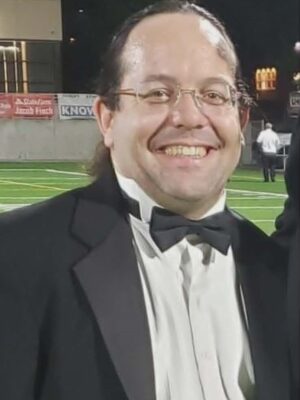
Emily’s ensemble directing experience includes band, jazz band, choir, and percussion ensemble. She co-founded the Marysville Joint Unified Mariachi program and is a co-conducter of the Yuba Sutter Community Concert Band in Olivehurst, California. Emily’s primary instruments are voice and clarinet and she also enjoys composing and arranging for her ensembles.
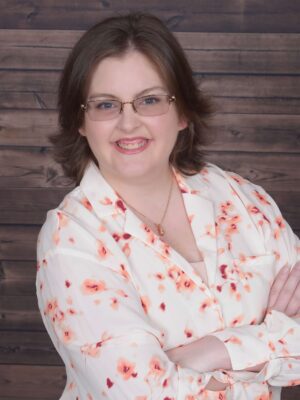
Emily Focht Kuersten
As a performer, Emily has had the honor of performing in a large ensemble with trumpet legend Doc Severinsen, the internationally renowned Canadian Brass ensemble, and premier mariachi ensemble Mariachi Sol De Mexico. She has also played under the baton of internationally renowned band composers Frank Ticheli and Robert W. Smith. In June of 2019, Emily had the privilege of performing on Omaha Beach in Normandy, France for the 75th anniversary of D-Day.
In her free time Emily enjoys travel, creating visual art, crafting, escape rooms, video games, and reading. She is also a passionate advocate for mental health awareness and support within the music education community. Emily currently lives in Rocklin, California with her husband Troy, her daughter Jamie, and her dog Rosie.